

Recording Pipettes
-
1. Using thin-wall glass capillaries with filaments (e.g., WPI #TW150F-3), create pipettes as appropriate for the target cell type.
-
For neurons with cell bodies 5–10 µm in diameter, pull pipettes with a tip diameter of ∼1 mm, and fire-polish using standard techniques (Molleman 2003).
-
For neurons with cell bodies 2–5 µm in diameter, the final tip diameter should be ∼0.5 µm, and pipettes should be shaped by pressure polishing. In a microforge equipped with 1500× total magnification, apply heat to the polisher filament while forcing ∼35 psi air down the lumen of the pipette.
-
While the tip is polished and the tip opening narrows, the taper of the pipette expands (Goodman and Lockery 2000; Johnson et al. 2008). Often a blunt taper is achieved before the tip opening has narrowed sufficiently. In this case, shut off the air and complete polishing with heat alone to obtain an appropriate tip diameter (Fig. 1).
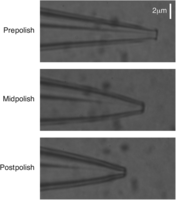 Figure 1.
Pipette tip morphology during the pressure polishing process. (Top) Before any polishing. (Middle) After polishing while applying pressure. A blunt taper forms; the tip diameter narrows slightly but is still too large for recording cells <5 µm in diameter. (Bottom) After final polishing. After the midpolishing stage, the air pressure is turned off, and polishing continues to narrow the tip opening to a final size of ∼0.5 µm.
-
-
-
3. Store the pipettes in a closed container to prevent accumulation of any dust particles, which could interfere with seal formation.
- © 2013 Cold Spring Harbor Laboratory Press



