

Cover image
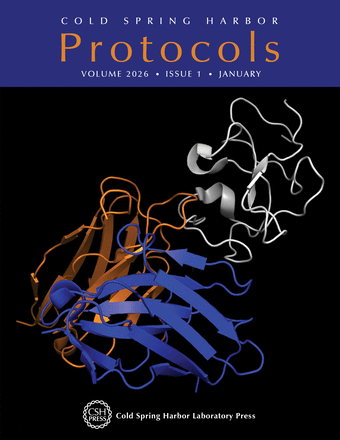
Due to their high affinity, specificity, sensitivity, and broad antigen recognition, rabbit monoclonal antibodies (mAbs) have become attractive reagents for research, and are increasingly being used in both diagnostic and therapeutic applications. Phage display of antibody repertoires, an approach that enables the production of antibodies against virtually any given antigen, can be used for the production of rabbit mAbs. Because human constant domains are more efficiently expressed in E. coli than rabbit constant domains, a chimeric rabbit/human Fab format, in which rabbit variable domains are recombinantly fused to human constant domains, is preferred for the selection of rabbit mAbs by phage display. In this issue, Peng and Rader describe the use of a pComb3 family phagemid derivative, pC3C, for the generation of chimeric rabbit/human Fab libraries, starting from the preparation of total RNA from rabbit spleen and bone marrow (doi:10.1101/pdb.prot108598). The cover image, prepared using PyMOL, shows a 1.2 Å crystal structure of a rabbit antibody bound to its human antigen (PDB: 6OSH). The variable domains of the rabbit light and heavy chains, shown in orange and blue, respectively, were generated by phage display following the protocols described in this issue. The human antigen, depicted in white, corresponds to the kringle domain of the receptor tyrosine kinase ROR2. Image provided by the authors.

