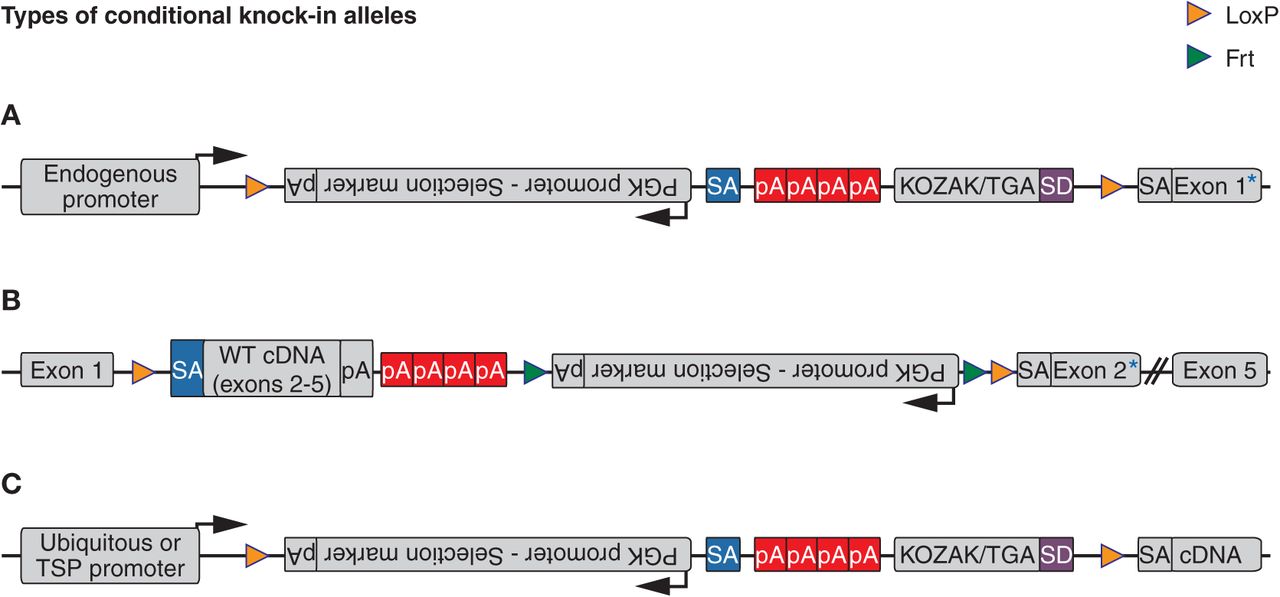
Design of conditional KI alleles. (A) The lox-stop-lox (LSL) cassette is targeted to an endogenous locus and prevents expression of the mutant gene. A Pgk promoter–driven selectable marker is transcribed in the opposite direction and has its own poly(A) signal (pA—gray). This is followed by a strong splice acceptor sequence (SA—blue), which serves as a 5′ splice donor trap to prevent unwanted splicing to the mutant exon 1 splice acceptor (SA—gray) before the excision of the STOP cassette. Multiple SV40-derived poly(A) sequences (pA—red) stop transcription. A Kozak-stop codon sequence blocks translation and a splice donor site (SD) immediately downstream of this “mini-exon” helps ensure that any splicing to the exon 1 SA would be translationally terminated. Following recombination at the loxP sites (orange triangles), the LSL cassette is excised and the mutant gene is expressed from the endogenous promoter. An asterisk denotes targeted mutation of interest. (B) The LSL cassette is targeted within an endogenous gene. Here, the LSL cassette contains a cDNA fragment encoding a portion of the wild-type gene, including the gene’s endogenous poly(A) signal, which is immediately followed by multiple additional poly(A) sites to prevent transcriptional readthrough of the mutant exon. To favor splicing to this cDNA fragment versus the downstream endogenous and mutated exon, a strong SA site is also included. A Pgk promoter–driven selectable marker is included to facilitate the identification of correctly targeted ES cells and should be excised in vitro following recombination at the Frt sites (green triangles). This design maintains expression of the wild-type gene from the endogenous promoter before Cre-mediated excision of the STOP cassette. An asterisk denotes targeted mutation of interest. (C) An LSL cassette followed by the cDNA of the gene of interest or a reporter allele can be targeted to a ubiquitous or TSP.