

Induction and Analysis of Synchronous Meiotic Yeast Cultures
- 1Center for Gene Regulation in Health and Disease, Department of Biological, Geological and Environmental Sciences, Cleveland State University, Cleveland, Ohio 44115-2214;
- 2North West Cancer Research Institute, School of Medical Sciences, Bangor University, Bangor LL57 2UW, United Kingdom
Abstract
Meiosis in Saccharomyces cerevisiae can be induced by deprivation of nutrients. Here, we present a protocol for inducing synchronous meiosis in SK1, the most efficient and synchronous yeast strain for meiosis, by exposing SK1 cells to liquid medium that contains potassium acetate as a nonfermentable carbon source and lacks nitrogen. These synchronous meiotic yeast cultures can be subjected to a range of molecular and cytological analyses, making them useful for investigating the genetic and molecular determinants of meiosis.
MATERIALS
Reagents
DAPI (4′,6-diamidino-2-phenylindole) stock solution (0.1 mg/mL)
Ethanol (40%, v/v)
Spheroplast storage buffer (SSB)
Water (deionized and sterilized)
Yeast presporulation medium (SPS)
Yeast sporulation medium (SPM)
Yeast strains of interest (stored at −80°C)
-
This protocol was optimized for SK1, a readily sporulating yeast strain. In a typical wild-type culture undergoing synchronous meiosis, >70% of cells have completed both meiotic divisions by 10 h after transfer to liquid SPM at 30°C (Padmore et al. 1991). Sporulation efficiency and spore viability usually exceed 90%.
Equipment
Centrifuge (with rotors and sterile centrifuge tubes ranging in sizes from 15 to 500 mL depending on the culture volume)
Coverslips for microscope slides (No. 1.5; 20 × 20 mm)
Falcon tubes (15 or 50 mL depending on sample volume)
Flasks
-
Use flasks that are 10 times the culture volume (e.g., 1-L flasks for 100-mL cultures). For cultures with volumes >300 mL, use 2.8-L triple-baffled Fernbach flasks (e.g., from Bellco Glass).
Fluorescence microscope (for DAPI analysis)
Incubators (stationary and shaking)
Microcentrifuge
Microcentrifuge tubes (1.5-mL; sterile)
Microscope slides
Pipette tips (filtered)
Roller drum
Spectrophotometer (OD600) and plastic cuvettes
METHOD
Induction of Synchronous Meiosis in Liquid Medium
-
This procedure was modified from Padmore et al. (1991) and Keeney (2009).
-
1. Thaw mutant and wild-type yeast strains of interest from stocks stored in 25% glycerol at −80°C. Transfer drop-sized samples onto an YPG agar plate and incubate overnight (∼16 h) at 30°C.
-
Overnight incubation on YPG medium, which contains glycerol as a nonfermentable carbon source, selects against spontaneously arising petite mutants that lack functional mitochondria. Petite mutants are defective for meiosis. For temperature-sensitive strains, perform all presporulation incubations at the permissive temperature.
-
-
2. Streak each strain for single colonies on separate YPD plates and incubate at 30°C until the colonies are ∼1.5–2 mm in diameter.
-
For a wild-type SK1 strain, incubation for 2 d at 30°C leads to single colonies ∼1.5–2 mm in diameter. Prolonged incubation under limiting nutrient conditions may trigger some cells to initiate meiosis and commit to meiotic recombination, potentially resulting in mutation-induced chromosome imbalances. For strains with mitotic growth defects, including temperature-sensitive mutants, incubate at the permissive temperature until the colony size reaches ∼1.5–2 mm in diameter.
-
-
3. Use a single colony to inoculate 4–5 mL of liquid YPD. Incubate on a roller drum with aeration for 24–26 h at 30°C.
-
4. Approximately 16–18 h before the desired time of meiosis induction, inoculate 100 mL of SPS in a 1-L flask with the YPD culture aiming for an OD600 of 0.01. Start with a 1/200 dilution (i.e., 0.5 mL into 100 mL of SPS) and adjust accordingly to obtain the correct OD by adding either more YPD culture or more SPS medium. Incubate with agitation at 200–300 rpm overnight at 30°C.
-
The volume of SPS culture can be scaled up to 450 mL depending on the nature of meiotic events to be analyzed. For example, use 100 mL for DAPI and FACS analyses and use 300–450 mL for physical analysis of recombination (see below). In all cases, the ratio between the culture volume and the flask size should be ∼1:10 to ensure adequate aeration. For culture volumes >200 mL, use a baffled Fernbach flask to enhance aeration.
-
-
5. When the OD600 of the culture reaches 1.2–1.4 (∼2 × 10⁷ cells/mL after 16–18 h incubation), harvest the cells by centrifuging at 3000g for 3 min at room temperature.
-
6. Wash the pellet once with one volume of prewarmed (30°C) SPM. Resuspend in 100 mL (i.e., the same volume as the SPS culture) of prewarmed SPM.
-
7. Start the synchronous meiotic time-course by incubating the culture in a shaker incubator at 30°C (or at a desired temperature) with vigorous agitation (≥350 rpm). Collect and store sample(s) of recommended volume from the flask at the appropriate time points, including t = 0 (see below and Fig. 1).
-
To determine the extent of synchrony by DAPI analysis, follow Steps 8–11. To collect and store samples for physical analysis of meiotic recombination by Southern analysis, follow Steps 12–16. To collect and store samples for cytological analysis of chromosomes, follow Steps 17–18. To collect and store samples for western blots, follow Steps 19–22. Typically, samples collected during synchronous meiosis are analyzed within a few days after the time course.
-
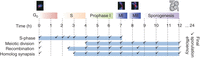
Timeline of key meiotic stages in wild-type SK1. Meiosis in budding yeast is induced by placing G0 cells into liquid sporulation medium (SPM), which lacks nitrogen and a fermentable carbon source. Above the timeline (data from Padmore et al. 1991) are nuclear morphologies of mono-, di-, and tetra-nucleate species, and a four-spore ascus observed before meiosis I (MI), after meiosis I (MI), after meiosis II (MII), and after sporogenesis, respectively. Blue indicates DNA and red indicates tubulin. Below the timeline are the durations of key meiotic events and the recommended time points of sample collection for analysis of a specific meiotic event.
Assessment of Efficiency and Synchrony of Meiotic Culture by DAPI Analysis of Nuclear Divisions
-
Recommended sample collection times for analysis of synchrony in a wild-type culture are 0, 4, 5, 6, 7, 8, 9, 10, 12, and 24 h (see Fig. 1).
-
8. Collect 1-mL samples of culture (from Step 7) and harvest the cells by centrifuging at 13,000g for 15 sec. Resuspend the cells in 250 µL of 40% ethanol.
-
The fixed cells can be stored for up to 1 wk at 4°C or for up to several months at −20°C.
-
-
9. Place 3 µL of DAPI solution on a microscope slide.
-
10. Vortex the fixed cells briefly to ensure that they are in suspension. Mix 3 µL of cells with the DAPI solution on the slide. Cover the cells immediately with a coverslip.
-
11. Under a fluorescence microscope equipped with a 100× oil-immersion objective and a DAPI filter, count the number of cells showing one, two, or three/four nuclei at each time point (Fig. 1).
-
We recommend starting with the 7-h sample of the wild-type culture, which should show 30%–60% of cells with ≥2 nuclei, indicative of completion of meiosis I (MI). An efficient wild-type culture typically contains ∼ 80% cells that have undergone MI by t = 10–12 h, with divided nuclei first appearing at ∼t = 5 h. Further analysis of transient meiotic events, including physical analysis of meiotic recombination and chromosome synapsis, should be limited to cultures showing good synchrony as indicated by occurrence of >70% of meiotic divisions within a 3-h time window.
-
Collection and Storage of Samples for Physical Analysis of Meiotic Recombination by Southern Analysis
-
Recommended sample collection times for analysis of meiotic recombination in a wild-type culture are 0, 2.5, 4, 5, 6, 7, 8.5, 10, 12, and optionally 24 h (see Fig. 1).
-
12. Harvest 9–25 mL of culture (from Step 7) by centrifuging at 4000g for 2 min at 4°C.
-
13. Wash with one volume of SSB at 4°C.
-
14. Resuspend in 1 mL of SSB at 4°C and transfer to a 1.5-mL microcentrifuge tube.
-
15. Centrifuge at 14,000g for 10 sec and remove the supernatant.
-
16. Freeze the cell pellet on dry ice and store at −80°C.
-
The experimental procedure for using these samples is described in Protocol: Analysis of Meiotic Recombination and Homolog Interaction during Yeast Meiosis (Börner and Cha 2015a).
-
Collection and Storage of Samples for Surface Spreading of Nuclei for Immunofluorescence Analysis
-
Recommended sample collection times for a wild-type culture are 0, 3, 4, 5, 6, 7, 8.5, 10, and 12 h (see Fig. 1).
-
17. Collect 1–10 mL of culture (from Step 7) and store on ice.
-
1 mL gives sufficient cell material for three microscope slides; the remaining sample volume can be used for additional analysis, such as for physical analysis of meiotic recombination.
-
-
18. Process samples for spreading within 3 d of collection (see Protocol: Analysis of Meiotic Recombination and Homolog Interaction during Yeast Meiosis [Börner and Cha 2015a]).
Collection and Storage of Samples for Western Blot Analysis
-
For recommended sample collection times for the process of interest, see Figure 1.
-
19. Collect 12 mL of culture (from Step 7), which should be sufficient for three western blot experiments. Harvest the cells by centrifuging at 3000g for 3 min at room temperature.
-
20. Discard the supernatant, and resuspend the cells in 1.2 mL of 30% glycerol.
-
21. Transfer 0.4-mL aliquots into three 1.5-mL microcentrifuge tubes.
-
22. Freeze the mixture on dry ice, and store at −80°C.
-
These samples are suitable for trichloroacetic acid whole-cell extract preparation following the method of Foiani et al. (1994).
-
DISCUSSION
Sporulation efficiency and synchrony of meiotic cultures are affected by both pre-growth and sporulation conditions. Notably, small fluctuations in the experimental conditions such as extent of aeration and temperature of a shaker incubator can often lead to substantial variations (e.g., Börner et al. 2004). It is not uncommon to observe such variations in meiotic progression in parallel cultures of the same genetic background, including wild-type cultures (Cha et al. 2000). As such, quantitative comparison between different experiments should be avoided unless the respective wild-type controls behaved comparably. We also recommend analyzing no more than four cultures at a time to minimize general sloppiness in sample handling, which tends to compromise efficiency and/or synchrony of meiosis.
Footnotes
-
↵3 Correspondence: g.boerner{at}csuohio.edu; r.cha{at}bangor.ac.uk
- © 2015 Cold Spring Harbor Laboratory Press



