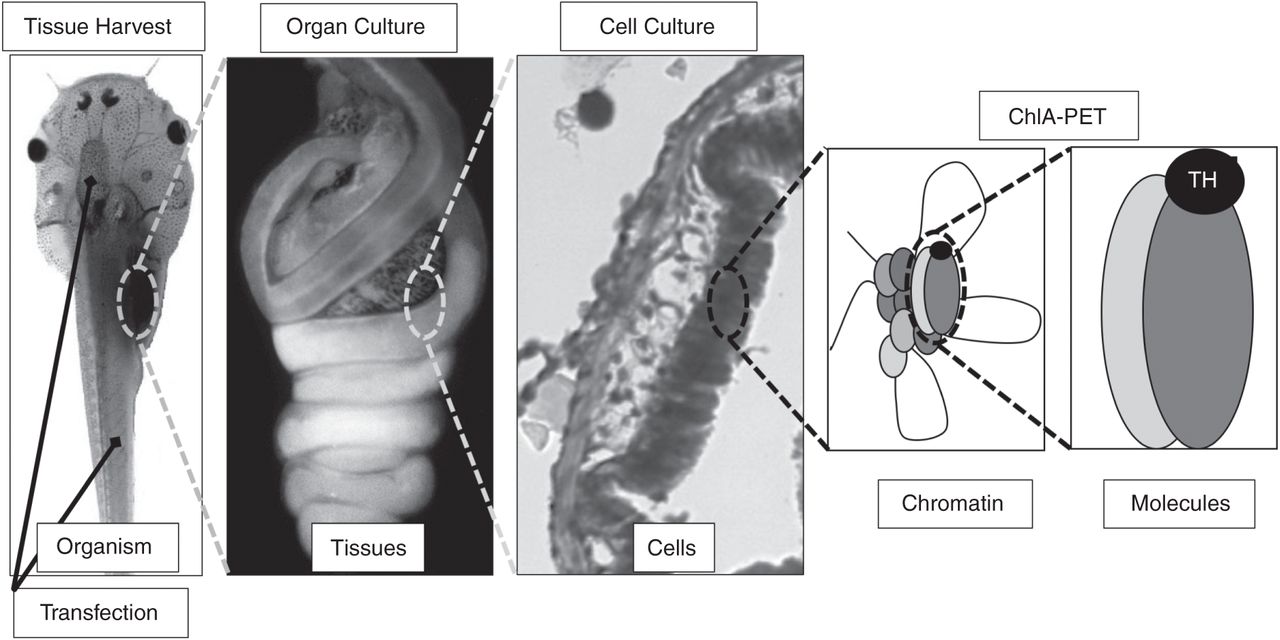
Levels of analysis of the Xenopus model to elucidate mechanisms of hormonal control of development. From left to right, the figure panels show decreasing biological levels from organism (tadpole) to tissues (whole intestine), cells (intestinal cross-section), chromatin structure (chromosomal looping) and molecules (receptor-hormone interaction, thyroid hormone [TH] bound to its nuclear receptor). The focal biological levels queried by the protocols introduced here are indicated. For tissue harvest, see Protocol: Xenopus Tadpole Tissue Harvest (Patmann et al. 2017); for transfection, see Protocol: Bulk Electroporation-Mediated Gene Transfer into Xenopus Tadpole Brain (Sáenz de Miera et al. 2018) and Protocol: In Vivo Transfection of Naked DNA into Xenopus Tadpole Tail Muscle (Marshall et al. 2017); for organ culture, see Protocol: Organ Culture of the Xenopus Tadpole Intestine (Ishizuya-Oka 2017); for cell culture, see Protocol: Cell Proliferation Analysis During Xenopus Metamorphosis: Using 5-Ethynyl-2-Deoxyuridine (EdU) to Stain Proliferating Intestinal Cells (Okada and Shi 2017); for ChIA-PET, see Protocol: Chromatin Immunoprecipitation for Chromatin Interaction Analysis Using Paired-End-Tag (ChIA-PET) Sequencing in Tadpole Tissues (Buisine et al. 2018a) and Protocol: Chromatin Interaction Analysis Using Paired-End-Tag (ChIA-PET) Sequencing in Tadpole Tissues (Buisine et al. 2018b).