Cover image
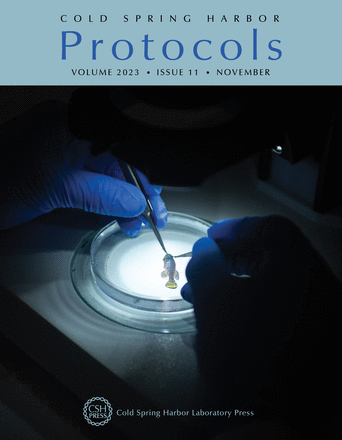
The world's population is aging, and this demographic phenomenon has unfortunately been accompanied by an increase in the prevalence of brain injuries and age-associated neurodegenerative diseases, which are often characterized by axonal pathology. The African turquoise killifish Nothobranchius furzeri is a short-lived fish species that has been established as a promising vertebrate model in aging research. In this issue, Vanhunsel et al. propose the killifish visual/retinotectal system as a model for investigating the central nervous system in an aging context. The authors describe a paradigm to induce and study both de- and regeneration of retinal ganglion cells and their axons (doi: 10.1101/pdb.prot107828). The cover image shows a male African turquoise killifish of the GRZ-AD inbred strain. The killifish is positioned underneath a stereomicroscope (Leica S9i), ready for an eye-related procedure. The image was acquired by Luca Masin and shows the hands of Steven Bergmans, both PhD students under supervision of Prof. Dr. Lieve Moons. Image provided by Prof. Dr. Lieve Moons.