Cover image
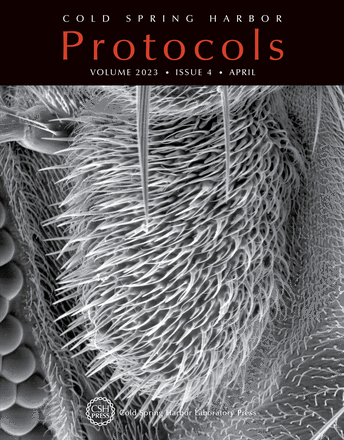
Drosophila provides an attractive model to study olfactory coding because it possesses a relatively simple peripheral olfactory system. Moreover, nearly all olfactory sensory neurons have been molecularly characterized and are accessible for physiological analysis, as they are exposed on the surface of sensory organs (antennae and maxillary palps), housed in specialized hairs called sensilla. In this issue, Benton and Dahanukar (doi:10.1101/pdb.prot108063) describe a protocol to perform recordings of odor-evoked activity from Drosophila olfactory sensilla. The image shows a scanning electron micrograph of a D. melanogaster antenna, revealing the morphologically diverse sensilla. An electrode can be inserted into an individual sensillum to record the odor-evoked responses of the neuron(s) it contains. The image was provided by the authors and is adapted from their previous work (Scalzotto M, Ng R, Cruchet S, Saina M, Armida J, Su CY, Benton R. 2022. Pheromone sensing in Drosophila requires support cell-expressed Osiris 8. BMC Biol 20: 230. doi:10.1186/s12915-022-01425-w).