Cover image
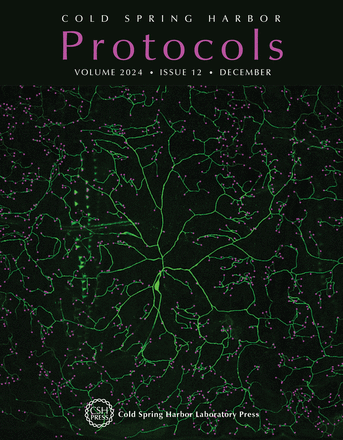
Neurons receive, process, and integrate inputs, and these operations are organized by dendrite arbor morphology. Indeed, dendritic morphology is a critical determinant of neuronal connectivity, and there is great interest in its characterization. Manual quantification of dendritic arbor morphometrics, however, is time-consuming and can be inaccurate. The dendritic arborization (da) neurons of the Drosophila peripheral sensory nervous system are an excellent experimental model for examining the differentiation processes that build and shape the dendrite arbor. In this issue, Kimura et al. describe a workflow for using DeTerm, a software tool that automatically recognizes dendrite branch terminals with high precision. It uses an artificial neural network to label, count, and provide the positional data for each terminal. The authors provide a protocol for detecting and counting dendrite branch terminals in da neurons, but the tool can also be used to examine many other types of neurons, including mouse Purkinje cells (doi:10.1101/pdb.prot108151). The cover image shows a c4da (ddaC) neuron (in green), and the corresponding output from DeTerm (in magenta). Image provided by Adrian W. Moore.