Cover image
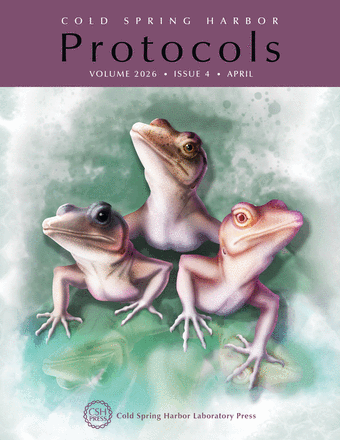
The Squamata—the reptile group comprising lizards and snakes—includes more than 11,000 described species. Among them, Anolis lizards are an ecologically diverse group that has been the subject of wide-ranging biological studies, from speciation and convergent evolution to climate adaptation and tail regeneration. Functional genetic analyses of these phenomena, however, have remained limited, hindering not only our ability to investigate the molecular mechanisms underlying these processes but also comparative analyses of gene function across vertebrates. This limitation stems largely from issues related to the reproductive biology of these reptiles, which makes the isolation of fertilized oocytes or single-celled embryos for gene-editing approaches impractical for most species. To overcome these challenges, Sabin et al. describe a surgical approach in the brown anole Anolis sagrei that enables microinjection of CRISPR–Cas9 ribonucleoprotein complexes into unfertilized oocytes while they are still maturing within the ovary, which allows for the routine production of gene-edited lizards (doi:10.1101/pdb.prot108652). The cover image depicts an artistic rendition of hatchling Anolis sagrei lizards; from left to right, the animals shown are tfec−/−, wild type, and tyr−/−. Image by Olivia Martin.