

Cover image
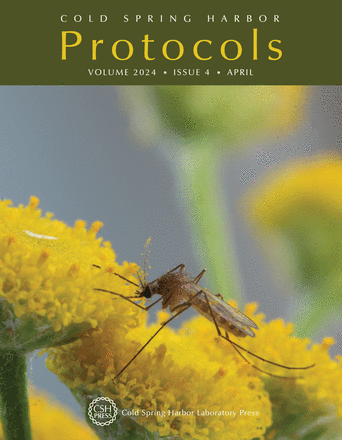
Sugary plant liquids represent essential food for mosquitoes, providing nutrients for survival, dispersal, and reproduction. Given the importance of mosquito nectar-feeding behavior, as well as its impact on vectorial capacity and its implications for vector suppression, a better understanding of mosquito–plant interactions is needed. Direct observation of mosquitoes visiting plants to obtain sugar and other nutrients, however, can be challenging. In this issue, Daniel A.H. Peach discusses methods for the detection of sugar in mosquitoes and for assessing mosquito pollination (doi:10.1101/pdb.top107666). The cover image shows a female Culex pipiens covered in pollen after visiting a composite flower of Tanacetum vulgare. The image was adapted from Peach DAH, Gries G, Arthropod–Plant Interactions 10: 497 (2016), with permission from Springer Nature.

