Cover image
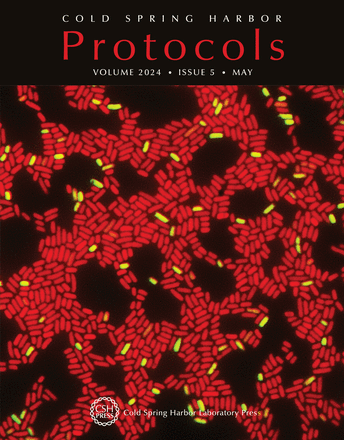
Reporter genes have been widely used to study gene expression patterns and their underlying regulatory mechanisms in multiple organisms, including bacteria. These reporters usually exhibit an inherent property that enables them to be directly measured (e.g., green fluorescent protein [GFP]) or some enzymatic activity that can be easily monitored (e.g., lacZ). When fused to an endogenous promoter of interest, the reporter typically mirrors the expression pattern of that promoter, thereby facilitating analysis. In this issue, Figueroa-Bossi et al. describe a system for the generation of libraries of random reporter gene fusions in bacteria, whereby a reporter (GFP or lacZ) is placed within a transposable element and engineered to be expressed only when fused to a gene, following random transposition (doi:10.1101/pdb.prot108196). Reporter gene fusions can help, for instance, reveal phenotypic heterogeneity within a population of genetically identical bacteria. Indeed, the cover image depicts Salmonella bacteria carrying two fluorescent reporter fusions—one to GFP and the other to another fluorescence reporter, mCherry—at separate chromosomal locations. Whereas the mCherry fusion is expressed homogeneously in all cells of the population, the gene fused to GFP exhibits a “bistable” pattern, characterized by the coexistence of two subpopulations of bacteria—one expressing the gene and the other not. (Image provided by the authors.)