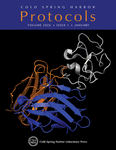
Cover image

Synthetic antibody libraries are constructed using chemically synthesized DNA and enable the development of antibodies that can recognize virtually any antigen, with affinity and specificity profiles that can be superior to those of natural antibodies. Such libraries have been used extensively, and have resulted in the development of specific, high-affinity antibodies to multiple targets for a variety of diagnostic and therapeutic applications. To generate these libraries, the immunological diversity and the antibody framework(s) that support(s) it outside of the binding regions must be carefully designed to ensure favorable functional and biophysical properties. In this issue, Gorelik et al. provide an overview of the design principles and considerations that have been used to generate high-quality synthetic antibody libraries, providing insights into the characteristics that make them a powerful tool for drug discovery (doi: 10.1101/pdb.over107759). Image designed by Freepik.