Cover image
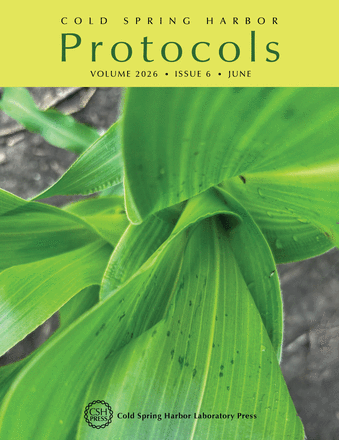
Zea mays (maize) is a globally important crop used for food, fuel, and livestock feed, and as a source of raw materials for industrial applications. Maize faces a range of biotic stresses, and it is constantly challenged by a variety of pathogens that can severely impact crop yield and quality. An important tool in the study and management of maize diseases is the use of controlled inoculation experiments, which allow researchers to evaluate germplasm for resistance and gain insight into plant–pathogen interactions. These studies often require screening hundreds to thousands of individual plants, for which high-throughput inoculations and phenotyping approaches are essential. Goss's wilt, caused by Clavibacter nebraskensis, is a bacterial foliar disease that causes gray foliar lesions and wilt, resulting in significant yield loss. In this issue, Mullens et al. describe a protocol for high-throughput inoculation of maize leaves with C. nebraskensis, enabling large-scale field evaluations of disease resistance (doi:10.1101/pdb.prot108642). The cover image shows a whorl of a maize plant that has been inoculated with C. nebraskensis via the pinprick technique described in the protocol. Pin holes in the leaves are visible, and the leaves are wet from the bacterial suspension. Image provided by the authors.