Cover image
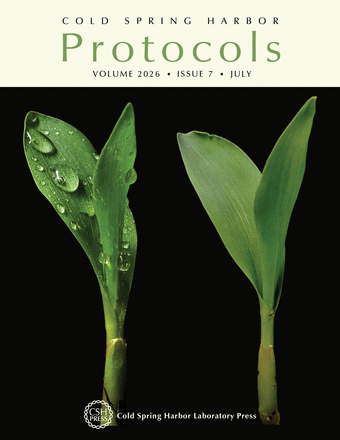
Recent advances in genome editing have revolutionized both basic and applied plant research by enabling highly programmable and targeted genetic modifications. These technologies facilitate not only detailed studies of gene function and the dissection of complex traits, but can also accelerate the development of improved cultivars. Among the various genome modification approaches currently in use, CRISPR–Cas-based genome editing has emerged as a transformative tool due to its precision, versatility, and ease of use. In particular, CRISPR–Cas9 has become the most widely adopted platform for genome manipulation in plant systems such as maize owing to its high editing efficiency, multiplexing capabilities, and scalability. Successful CRISPR–Cas9 editing in maize, however, depends on the precise execution of multiple interdependent steps, from guide RNA design and vector construction to efficient plant transformation and genotyping analysis, each of which requires careful optimization. In this issue, Char et al. provide a comprehensive protocol for CRISPR–Cas9 editing in maize, describing the steps from vector design and assembly to the identification of CRISPR-induced mutations in transgenic maize seedlings (doi:10.1101/pdb.prot108659). The cover image shows a wild-type maize plant (right), alongside a loss-of-function mutant generated by CRISPR–Cas9 editing of the glossy2 (GL2) gene, which is important for epicuticular wax deposition on plant surfaces (left). Compared to the “glossy” leaf surface of the wild type, gl2 maize plants exhibit a dull leaf surface that retains water droplets. Image provided by the authors, and adapted from Plant Biotechnol J, 17: 362–372 (https://doi.org/10.1111/pbi.12982).