

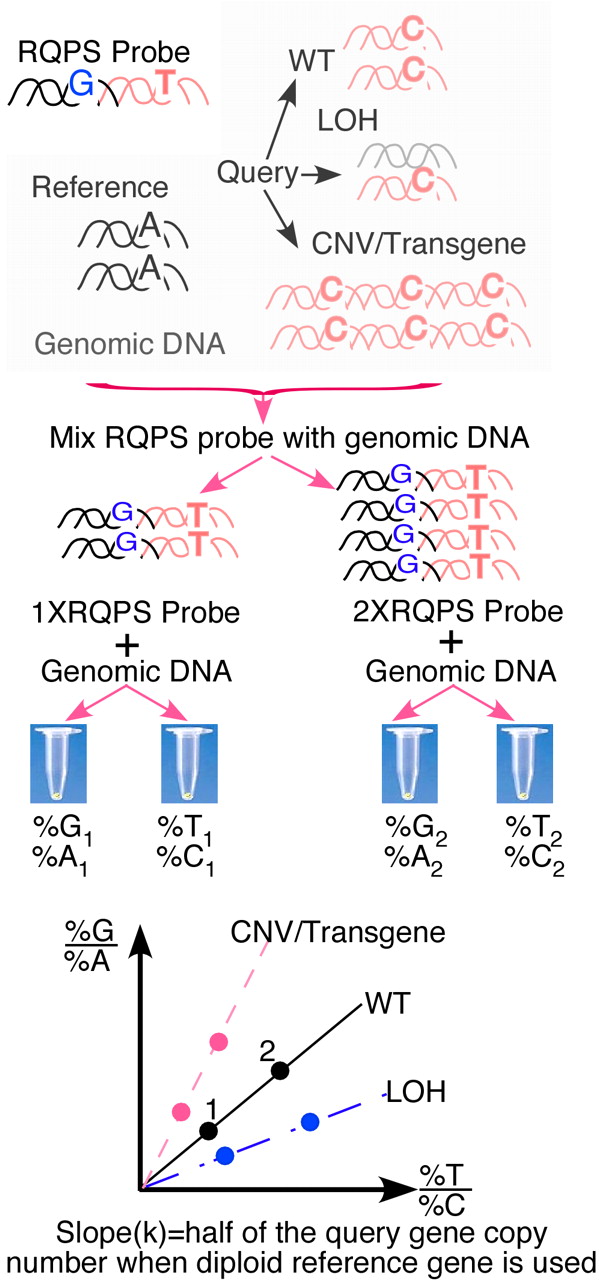
Principle of RQPS. The RQPS probe consists of two physically linked DNA fragments. One matches a reference allele with known CNs in a genome (black) and the other the query allele (pink). Each has a SNV to differentiate it from its counterparts in the genome (G vs. A for the reference and T vs. C for the query in this example). When different amounts of probe and genomic DNA are mixed, their molar ratio can be determined by quantitative pyrosequencing of either the reference (%G/%A) or the query (%T/%C) SNV. The value of this ratio will be equal (%G/%A=%T/%C) if the CN of the query allele equals that of the reference allele. Otherwise, they will be unequal. Specifically, when %G/%A is plotted against %T/%C, a line through the origin (0, 0) is expected, and the CN of the query gene equals the product of the slope of this line and the CN of the query gene. (Reprinted from Liu et al. 2009.)



