

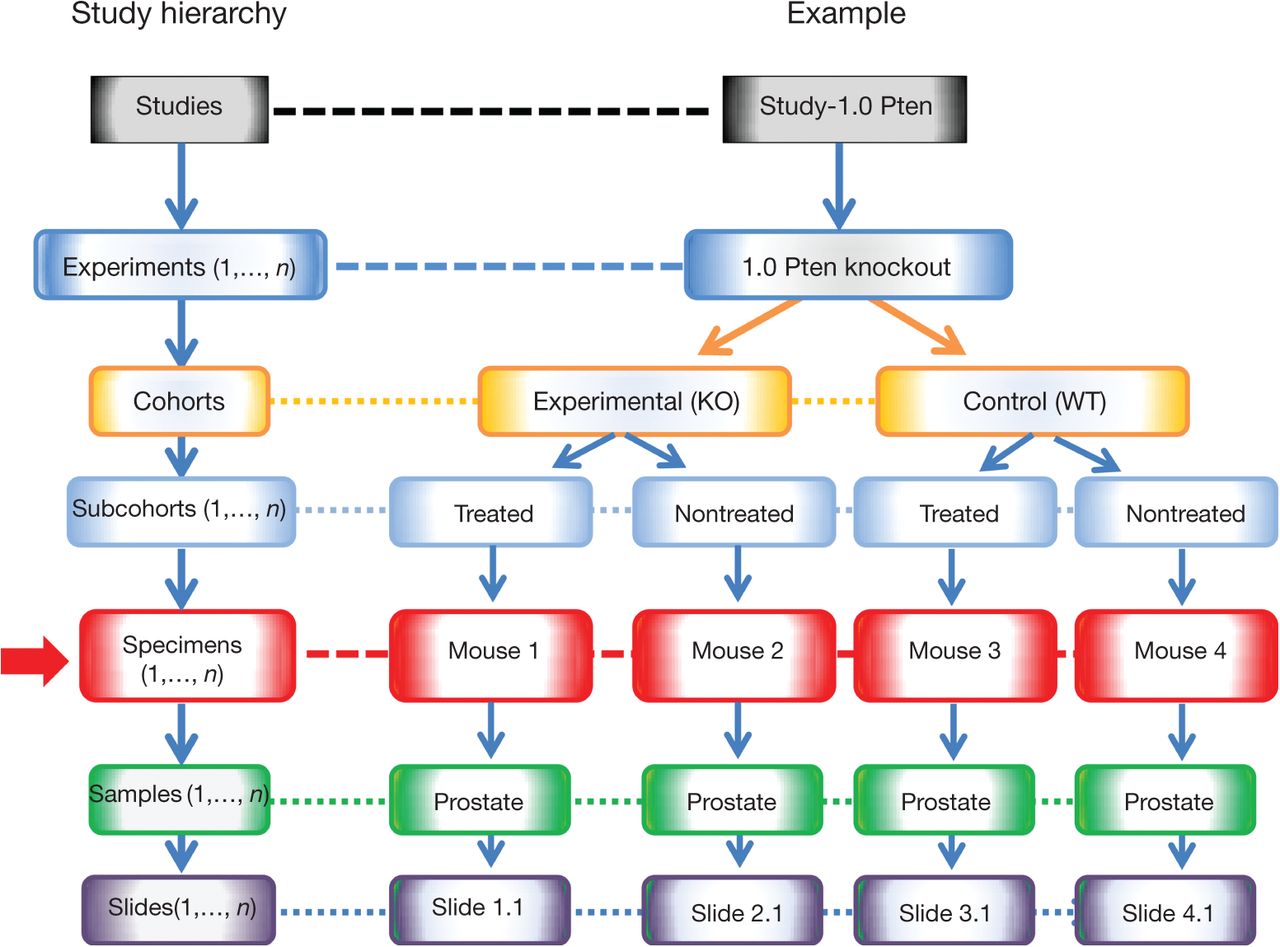
Study hierarchy. This figure depicts the application of the ontogeny for experimental design. The ontogeny, labeled Study hierarchy, follows Aristotelian rules. In most clinical settings, the organism, be it a mouse or human, is the subject (red arrow) and carries the universal identifier. The Specimen (red box) (or specimen) is the equivalent of Organism in Ontology C (violet box) of Figure 1. The Slides are the children of a Sample, the Samples are children of a Specimen, the Specimens are children of a Subcohort, the Subcohorts are children of a Cohort, the Cohorts are children of an Experiment, and the Experiments are children of a Study. In practice, Slides belong to an organ (Sample) (e.g., prostate) in an animal (Specimen) (e.g., Mouse 1, …, n), all Specimens belong to a Subcohort (treated or untreated), Subcohorts belong to a Cohort (Experimental or Control), Cohorts belong to an Experiment (e.g., Pten KO) and all Experiments belong to a Study (e.g., Pten). By using these simple rules, the investigator and computer can track the origin and distribution of multiple levels of information while maintaining order in relationship to each animal and their samples. This ontogeny is also consistent with the anatomic ontogeny in Figure 1.



