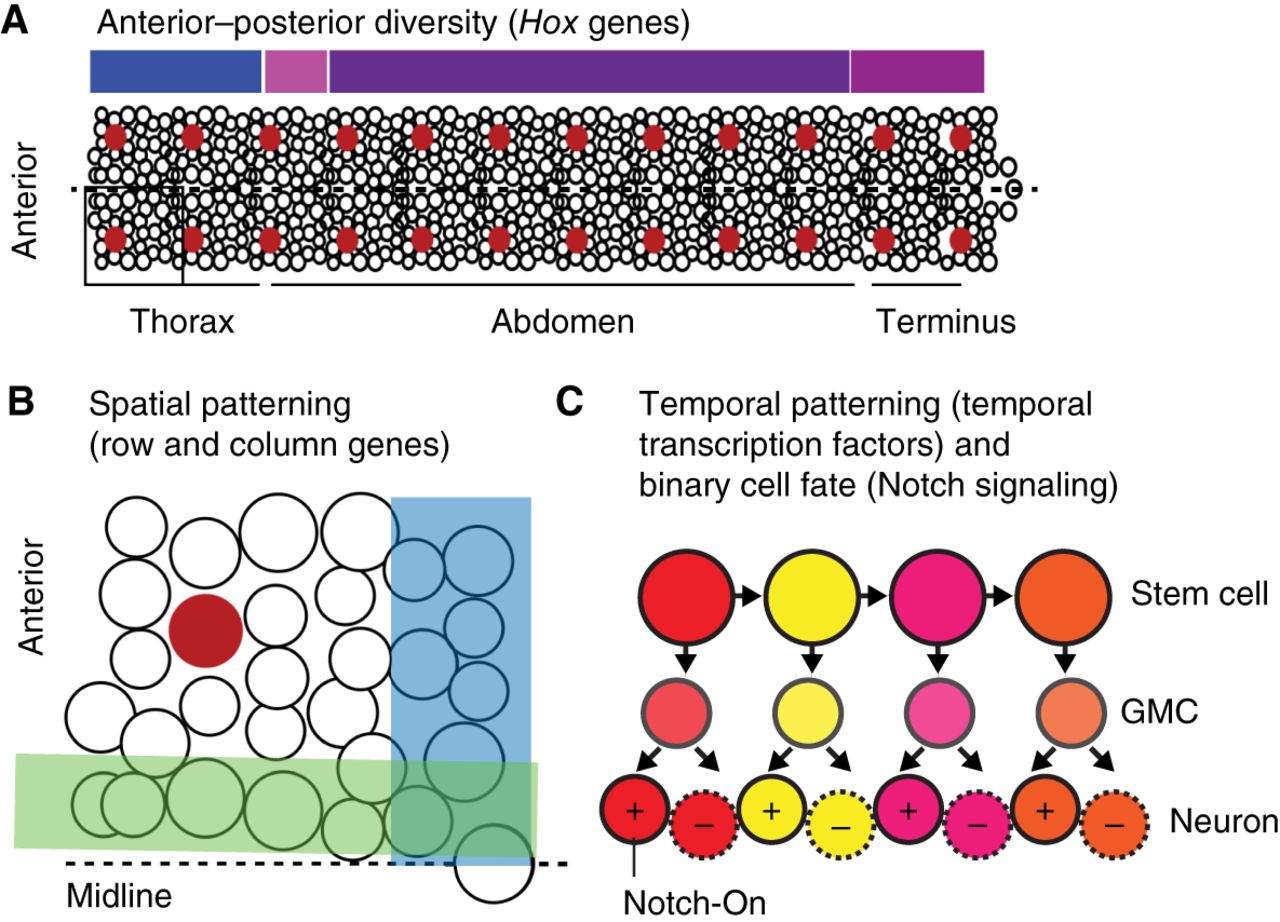
The generation of neural diversity in Drosophila nerve cord. (A) Neuroblasts are arrayed along the anterior–posterior axis. Each circle represents one neuroblast. The midline is represented by a dashed line. A representative neuroblast, NB3-3, is shown in red to highlight the left–right symmetrical and serially homologous organization of the nerve cord. An example of a nonrepeating unit, a hemineuromere, is shown in the box at the bottom left and is enlarged in B. Above the nerve cord, colored bars show approximate zones of Hox gene expression. Regions of the nerve cord are labeled below. (B) A single hemineuromere (box in A) is shown. Each neuroblast is distinct due to row and column gene expressions, which are represented by blue and green stripes. (C) The illustration shows neuroblast lineage progression. Each circle represents one cell, and each arrow represents a cell division. The top row contains neuroblasts that divide to self-renew and generate a ganglion motor cell (center row). (Bottom row) Ganglion mother cells (GMCs) divide asymmetrically to generate two neurons. Neurons become different from each other based on Notch signaling, with cells labeled with “+” representing Notch-On neurons and the others representing Notch-Off neurons. Temporal transcription factor expression in neuroblasts is dynamic, changing on each division, with each color representing a different temporal transcription factor. However, temporal transcription factors are maintained in the progeny generated at specific birth times (they keep their color).