Isolation of rare antigen-binding antibody domains by affinity selection. An antigen of interest (red in the figure) is immobilized on a solid substrate of some kind. The antigen-coated substrate is exposed to the library—the “input” to the affinity selection process. Rare virions whose displayed antibody domains happen to bind the immobilized antigen are captured on the substrate surface, while all other virions—the overwhelming majority—remain free in solution. Virions that have not been captured are thoroughly washed away, leaving only the captured virions on the surface. The captured virions are released from the substrate in some manner, resulting in an “output” virion population that is greatly enriched for virions displaying antigen-binding antibody domains. No clone in the output population is present in sufficient numbers to permit meaningful characterization, or to serve as input to another round of capture and release. Instead, taking advantage of the physical link between the displayed antibody domain and its coding sequence in the phage genome, the output virions are greatly “amplified” (propagated) by infecting fresh bacterial host cells with output virions, and culturing the infected cells in growth medium. The amplified output population is then analyzed to identify clones of interest (those displaying antibody domains of interest), or used as input to another round of capture, release, and amplification.
Figure 2.

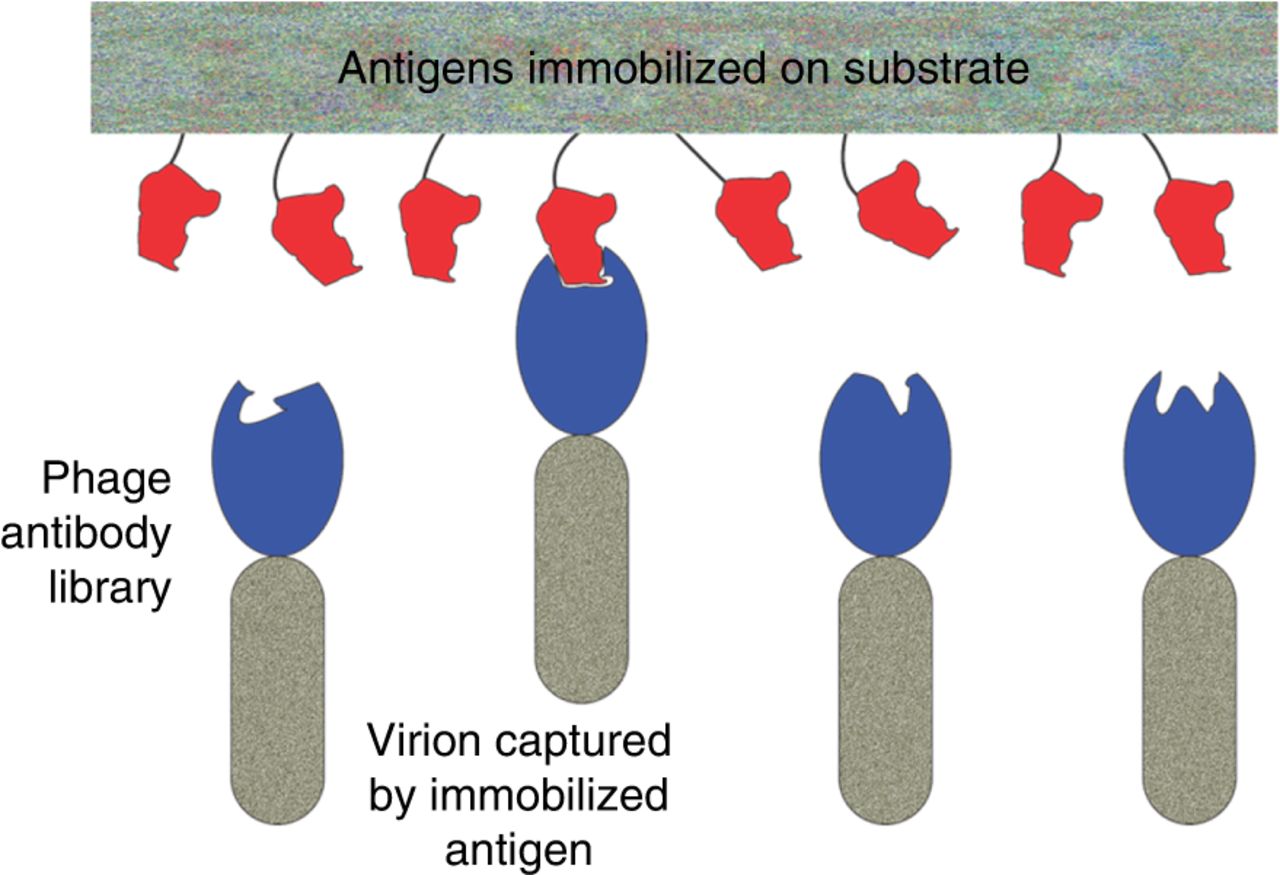
Isolation of rare antigen-binding antibody domains by affinity selection. An antigen of interest (red in the figure) is immobilized on a solid substrate of some kind. The antigen-coated substrate is exposed to the library—the “input” to the affinity selection process. Rare virions whose displayed antibody domains happen to bind the immobilized antigen are captured on the substrate surface, while all other virions—the overwhelming majority—remain free in solution. Virions that have not been captured are thoroughly washed away, leaving only the captured virions on the surface. The captured virions are released from the substrate in some manner, resulting in an “output” virion population that is greatly enriched for virions displaying antigen-binding antibody domains. No clone in the output population is present in sufficient numbers to permit meaningful characterization, or to serve as input to another round of capture and release. Instead, taking advantage of the physical link between the displayed antibody domain and its coding sequence in the phage genome, the output virions are greatly “amplified” (propagated) by infecting fresh bacterial host cells with output virions, and culturing the infected cells in growth medium. The amplified output population is then analyzed to identify clones of interest (those displaying antibody domains of interest), or used as input to another round of capture, release, and amplification.

This Article

  1. Cold Spring Harb Protoc 2026: pdb.over107753-